
"Most players skate to where the puck is. But I skate to where the puck is going to be."
Wednesday, November 09, 2005
Thought for the Day
My husband, Ron, delights in finding thought provoking quotes and using them in his signature line on his e-mails. I find this one by Wayne Gretzky to be directive when we do planning for the future.


Monday, November 07, 2005
A Cloud of Witnesses
As we incorporated several themes within our worship yesterday, I observed that faithful Christian stewardship is a discipline of spirit and action...prayers, projects, practice, doing, being. Those who have chosen to walk this path are the true saints among us. They are the ones who surround and encourage us and lead us into the future.
"For all that has been--Thanks!
For all that will be--Yes!"
Dag Hammarskjold
Sunday, November 06, 2005
A New Thing
My office has been in a chaotic state for several weeks as a new space for a program assistant is being created. Finding books and resources in boxes isn't fun and everything is covered with a fine dust. The good part of all of this is that I am finding interesting things. Yesterday, I found some undocumented notes that were thought-provoking. Included was the following:
Lovett Weems* says that the task of leaders is not to resolve conflict through victory for one side or compromise for the other, but to watch for God's new creation to emerge. Often a third alternative becomes the "new thing" God is doing in our midst.
As church leaders we often strive for the former and not allow the latter to happen. However, when we patiently let the process of hearing God's Spirit speak to us exciting new life seems to follow. Give us the vision to listen as we move through what Ken identifies as transitional time in the life of this congregation.
*Dr. Lovett Weems is past president of St. Paul School of Theology and now serves as the Director of the Lewis Center for Church Leadership and Distinquished Professor at Wesley Seminary. Both are United Methodist seminaries. I have read several of his books and been fortuate to hear him speak several times about church leadership.
Saturday, November 05, 2005
Charge Conference
As we prepared to gather for our annual charge conference on Tuesday evening, I once again realized that our members really don't understand the meaning of a charge conference. Briefly, this basic governing body of each United Methodist church is composed of all members of the Administrative Board or Council and must meet at least once a year. This yearly meeting reviews and evaluates the ministry of the church, sets salaries for the pastor and staff, elects lay leadership for the coming year and recommends candidates for ordained ministry. The District Superintendent usually presides. To me one of the more important aspects of this conference is that it reminds us of our Wesleyan heritage and connects us with the greater United Methodist Church as we follow certain requirements of THE DISCIPLINE. Congregations are held accountable to one another. Next year, I need to offer more explanation to the congregation about the purpose and importance of a charge conference.
Our District Superintendent, Rev. Quay Adams, presided at this year’s charge conference. He asked us two questions that should serve as an evaluative guide to our current and future ministry.
“What are you doing to make disciples of Jesus Christ?”
“What are you doing uniquely?”
These are certainly good questions to keep before us as we plan and do in the coming year.
Our District Superintendent, Rev. Quay Adams, presided at this year’s charge conference. He asked us two questions that should serve as an evaluative guide to our current and future ministry.
“What are you doing to make disciples of Jesus Christ?”
“What are you doing uniquely?”
These are certainly good questions to keep before us as we plan and do in the coming year.
Friday, November 04, 2005
John Wesley
For the past few years five days a week, I have been reading an e-mail message from Conrad Archer, a United Methodist clergy person from Texas, about John Wesley. He has offered insight into Mr. Wesley by quoting short passages from Wesley's extensive writings in a chronological order. Today is the last regular offering of Days of Wesley. I have found the following to be a good summary by Rev. Archer of what we have gleaned and worth pondering.
The Character of the Man: John Wesley
John Wesley was one of the finest Christians this side of Saint Paul. He was not a great philosophical theologian; but very few could claim to outrank him in terms of practical theology. We see him fully enmeshed in the culture of 18th century England; yet, his life-style could easily be adapted to any time, any location.
He lived in a time colored by beliefs in supernatural entities, e.g. witches, ghosts and demons; but his rational thought would not allow him to be detracted from a positive spirituality. In an age of predominantly deistic thought, he unwaveringly perceived the active intervention of God in all aspects of human life. He was among the most active evangelists of all ages, yet his focus was on spiritual growth into holiness.
His thirst for knowledge pushed him into being among the most learned men of his age, yet he balanced his vast knowledge with an always present quest for vital piety. He was totally dedicated, for all his life, to the proposition that each Christian should strive for, and could achieve, having the mind of Christ within. Few scholars could claim to have read more works of history, medicine, literature, science, etc. But, no man of his time knew and used the contents of the Holy Bible more than he did.
He was a proper English gentleman, yet he strode out into the middle of pastures, drawing thousands of listeners to hear him preach. Often standing on city streets, he would break into a psalm, singing until a small crowd had gathered. Then he would begin his sermon.
When his people were sick and no doctor was available, he treated their illnesses with practical remedies. When banks would not loan money to the poor, he started a "credit union" to help the poor make their way. When hunger plagued the people, Wesley himself would walk the streets begging for resources to feed the impoverished.
Wesley was amazingly inclusive of people with different religious views; but, was exceedingly intolerant of people who argued about their beliefs. Contentiousness was a certain invitation to leave a society. Wesley's main concern was that his people would be holy people, filled with God's love. In 1746, in a preface to a collection of sermons, he wrote:
The Character of the Man: John Wesley
John Wesley was one of the finest Christians this side of Saint Paul. He was not a great philosophical theologian; but very few could claim to outrank him in terms of practical theology. We see him fully enmeshed in the culture of 18th century England; yet, his life-style could easily be adapted to any time, any location.
He lived in a time colored by beliefs in supernatural entities, e.g. witches, ghosts and demons; but his rational thought would not allow him to be detracted from a positive spirituality. In an age of predominantly deistic thought, he unwaveringly perceived the active intervention of God in all aspects of human life. He was among the most active evangelists of all ages, yet his focus was on spiritual growth into holiness.
His thirst for knowledge pushed him into being among the most learned men of his age, yet he balanced his vast knowledge with an always present quest for vital piety. He was totally dedicated, for all his life, to the proposition that each Christian should strive for, and could achieve, having the mind of Christ within. Few scholars could claim to have read more works of history, medicine, literature, science, etc. But, no man of his time knew and used the contents of the Holy Bible more than he did.
He was a proper English gentleman, yet he strode out into the middle of pastures, drawing thousands of listeners to hear him preach. Often standing on city streets, he would break into a psalm, singing until a small crowd had gathered. Then he would begin his sermon.
When his people were sick and no doctor was available, he treated their illnesses with practical remedies. When banks would not loan money to the poor, he started a "credit union" to help the poor make their way. When hunger plagued the people, Wesley himself would walk the streets begging for resources to feed the impoverished.
Wesley was amazingly inclusive of people with different religious views; but, was exceedingly intolerant of people who argued about their beliefs. Contentiousness was a certain invitation to leave a society. Wesley's main concern was that his people would be holy people, filled with God's love. In 1746, in a preface to a collection of sermons, he wrote:
For how far is love, even with many wrong opinions, to be preferred before truth lf without love. We may die without the knowledge of many truths and yet be carried into Abraham's bosom. But if we do without love, what will knowledge avail?
John Wesley, WORKS (Bic Ed) 1, 107, 1746.
Conrad Archer
Wednesday, November 02, 2005
Issac J. Bailey
I regularly read Issac Bailey's column, A Different Perspective, in THE SUN NEWS. I don't always agree with what he says, but I always find it well written and thought provoking. So, when I read this morning that he is now writing a blog, A Different World, I immediately logged on and found a compelling interview of a visiting journalist about the genocide in Rwanda. Tonight, I revisited this blog to read the comments to it and was encouraged with the initial response. I think Mr. Bailey has given us a legitimate opportunity for thoughtful dialogue and I commend it to others to read.
Monday, October 31, 2005
A Place Called Home
As we return to South Carolina from a few days in Ohio, I have memories of one more journey to that place called home. Long ago I realized this not only means the geographical location, a farm near Jeffersonville, Ohio, but also a place in my heart. Both understandings have been very much part of this trip. From being with my sister and husband who are dealing with his serious illness to seeing my parents who are experiencing the realities of aging, it has been an opportunity to remember so many things that have been important to me through the years. I also have had the chance to do what family members can do best...hold one another close in time of trial. As the miles once again begin to separate us, I know that I am not really leaving home for it truly is a place in my heart.
Beckley, West Virginia
Sunday, October 30, 2005
Ancient Future Worship
My niece, Carrie, sent me this article from the Washington Post.
In addition to experiencing some of this type of spirituality in recent years, I have heard and read about what Robert Webber identifies as ancient future worship. Other writers like Leonard Sweet write, "Our faith is ancient. Our faith is future. We're old-fashioned. We're new-fangled. We're orthodox. We're innovators. We're postmodern Christians." All of this seems to be part of what is now being called emerging worship. For some this may seem to be a disconnect with what they know to be worship. Others find it to be quite transparent as they look at what is happening within their worshipping communities. And, there are others who opine that this is the new Reformation. (Got to use the current pop words!)
It is interesting that today is Reformation Sunday. Wonder what Martin Luther would think of this?
In addition to experiencing some of this type of spirituality in recent years, I have heard and read about what Robert Webber identifies as ancient future worship. Other writers like Leonard Sweet write, "Our faith is ancient. Our faith is future. We're old-fashioned. We're new-fangled. We're orthodox. We're innovators. We're postmodern Christians." All of this seems to be part of what is now being called emerging worship. For some this may seem to be a disconnect with what they know to be worship. Others find it to be quite transparent as they look at what is happening within their worshipping communities. And, there are others who opine that this is the new Reformation. (Got to use the current pop words!)
It is interesting that today is Reformation Sunday. Wonder what Martin Luther would think of this?
Wednesday, October 26, 2005
The Way It Was
As a Minister of Education I work closely with those who have answered the call to youth ministry. Over the years I have had the pleasure of working with a variety of persons who each have brought unique gifts to the roles of youth director, teacher and counselor. I will admit there have been tense times when I have found myself caught between supporting these persons in their ministry and appeasing parents and other adult leadership who always have a better idea. These moments usually begin with phrases such as… “When we (or my kids) were teens, we had a strong youth program. We had fundraisers, went on retreats, had a great Sunday school and everyone in town thought our program was the best. So and so was the youth director then and we need someone just like him/her.” And the discontent begins…
Those days probably were wonderful, but I have come to realize we are only hurting our youth when we don’t make the effort to create a program that responds to the needs of this generation.. And, it is the youth and the youth leaders that can often give us the good insights for this. However, we fail to listen and keep on promoting our own thoughts and ideas. Before long youth directors leave in frustration and youth leave the church, because we haven’t provided spiritual fulfillment. All we have provided is lots of activity. Where in the Bible is it written that every youth group must take a ski trip? Our teens do not need more activities for the sake of having something to do. They lead a frantically busy life. But, many want to explore their spiritual life and to have opportunities to practice their faith in relationship with one another. Activities can be a tool for this. However, without a strategy or long term plan that allows teens to know the transforming love of God through Jesus Christ, our youth programs will disappear when “the way it was” becomes the theme for youth ministry. Let’s be open to new possibilities and offer our youth, youth leaders and teachers support in their efforts as they seek to create a youth ministry that nurtures faithful discipleship in today's world.
Those days probably were wonderful, but I have come to realize we are only hurting our youth when we don’t make the effort to create a program that responds to the needs of this generation.. And, it is the youth and the youth leaders that can often give us the good insights for this. However, we fail to listen and keep on promoting our own thoughts and ideas. Before long youth directors leave in frustration and youth leave the church, because we haven’t provided spiritual fulfillment. All we have provided is lots of activity. Where in the Bible is it written that every youth group must take a ski trip? Our teens do not need more activities for the sake of having something to do. They lead a frantically busy life. But, many want to explore their spiritual life and to have opportunities to practice their faith in relationship with one another. Activities can be a tool for this. However, without a strategy or long term plan that allows teens to know the transforming love of God through Jesus Christ, our youth programs will disappear when “the way it was” becomes the theme for youth ministry. Let’s be open to new possibilities and offer our youth, youth leaders and teachers support in their efforts as they seek to create a youth ministry that nurtures faithful discipleship in today's world.
Monday, October 24, 2005
Festival of Faith
What a rich experience to hear the word proclaimed by Jan Brittain! Jan is an ordained United Methodist minister from Greensboro, NC. As an adopted daughter of this church, it is always like a homecoming when she is with us. During our Festival of Faith, she has challenged us “to keep the body of Christ healthy and fit in the world today.” Drawing on the book of Acts, Jan has reminded us that it is the power of the Holy Spirit that allows us to live in faithfulness as individuals and as a community of believers.
I have especially appreciated Jan’s understanding of Barnabas, Paul’s encourager, and the importance of such persons within the church. Her sermon has led me to remember those persons who have encouraged me to be more than I have known myself to be. What a gift they have given me! I trust it has been important to the church, the body of Christ, as well. From those who invited and encouraged me to serve the church in a variety of ways as a layperson to those who helped me hear the call to ordained ministry, I can name so many significant persons in my life. But, Jan’s message isn’t about what has been, but what must be for the body of Christ to be healthy today. So, how can I be a Barnabas to others?
I have especially appreciated Jan’s understanding of Barnabas, Paul’s encourager, and the importance of such persons within the church. Her sermon has led me to remember those persons who have encouraged me to be more than I have known myself to be. What a gift they have given me! I trust it has been important to the church, the body of Christ, as well. From those who invited and encouraged me to serve the church in a variety of ways as a layperson to those who helped me hear the call to ordained ministry, I can name so many significant persons in my life. But, Jan’s message isn’t about what has been, but what must be for the body of Christ to be healthy today. So, how can I be a Barnabas to others?
Wednesday, October 19, 2005
Claiming the Land

When I saw the above picture, my heart melted. Our grandson, William, was visiting my Ohio home. For a few days he had an opportunity to sense his rich heritage of those who love the land. The land is the canvas for telling our family story and each one of us knows what it means when we say, “the farm”. We remember the stories of each generation that has lived on this land and how the land has shaped them. Some members have stayed and others have moved on to other places taking a bit of the land’s story with them.
The Bible is the story of God’s people with God’s land and its promise. The biblical saga of the promised land is echoed in other stories through the ages including the Owens family. Five generations on this piece of land have trusted the earth for fruitful harvest and have known the sense of joy of belonging to an ordered and bountiful creation. Like the wandering Israelites, we have held fast to the promise of the land through times of tribulation. The land is our past, our present, and our future.
Tuesday, October 18, 2005
Read-Aloud
We have recently added some good parenting resources in our church library including one that I enjoyed using when my sons were young. The Read-Aloud Handbook by Jim Trelease is now in its fifth edition and still contains wonderful information. The author writes not only about the importance of reading aloud, but also some of the do’s and don’ts. He also includes a listing of over 1500 books from wordless books to full-length novels to be read-aloud to children. Each listing has a brief description and recommended age-level.
Looking through The Read-Aloud Handbook certainly took me down memory lane. Authors such Margaret Wise Brown, E. B. White, and Dr. Suess were early favorites of my sons. I remember Dan laughing at Amelia Bedelia and Curious George. Rob loved James and the Giant Peach by Roald Dahl and Soup by Robert Newton Peck. Later, The Cay by Theodore Taylor and The Chronicles of Narnia by C.S. Lewis were at the top of the list of must-reads.
During our sons' elementary years, I especially liked the books by Katherine Paterson, Beverly Cleary, Betsy Byars and Judy Blume as their writings had a sensitivity to the issues important for us to discuss. Matters of life and death, friendship, family, justice, and heartache were often explored in a way that invited healthy conversation. It is interesting to note that our sons liked these books, also.
I don’t think I fully understood the importance of this time we spent reading. I was focused on doing the right thing so that they would be good readers and enjoy it. However, the parent-child relationship strengthened, the questions spawned, the imagination inspired, and the creativity nurtured were also important rewards. It certainly is part of sacred memory for me. May my grandchildren and all children share such rich moments.
Looking through The Read-Aloud Handbook certainly took me down memory lane. Authors such Margaret Wise Brown, E. B. White, and Dr. Suess were early favorites of my sons. I remember Dan laughing at Amelia Bedelia and Curious George. Rob loved James and the Giant Peach by Roald Dahl and Soup by Robert Newton Peck. Later, The Cay by Theodore Taylor and The Chronicles of Narnia by C.S. Lewis were at the top of the list of must-reads.
During our sons' elementary years, I especially liked the books by Katherine Paterson, Beverly Cleary, Betsy Byars and Judy Blume as their writings had a sensitivity to the issues important for us to discuss. Matters of life and death, friendship, family, justice, and heartache were often explored in a way that invited healthy conversation. It is interesting to note that our sons liked these books, also.
I don’t think I fully understood the importance of this time we spent reading. I was focused on doing the right thing so that they would be good readers and enjoy it. However, the parent-child relationship strengthened, the questions spawned, the imagination inspired, and the creativity nurtured were also important rewards. It certainly is part of sacred memory for me. May my grandchildren and all children share such rich moments.
Sunday, October 16, 2005
Friendship
“Faithful friends are a sturdy shelter: whoever finds one has found a treasure.” Sirach 6:14 (also known as Ecclesiasticus in the Apocrypha of the Old Testament)
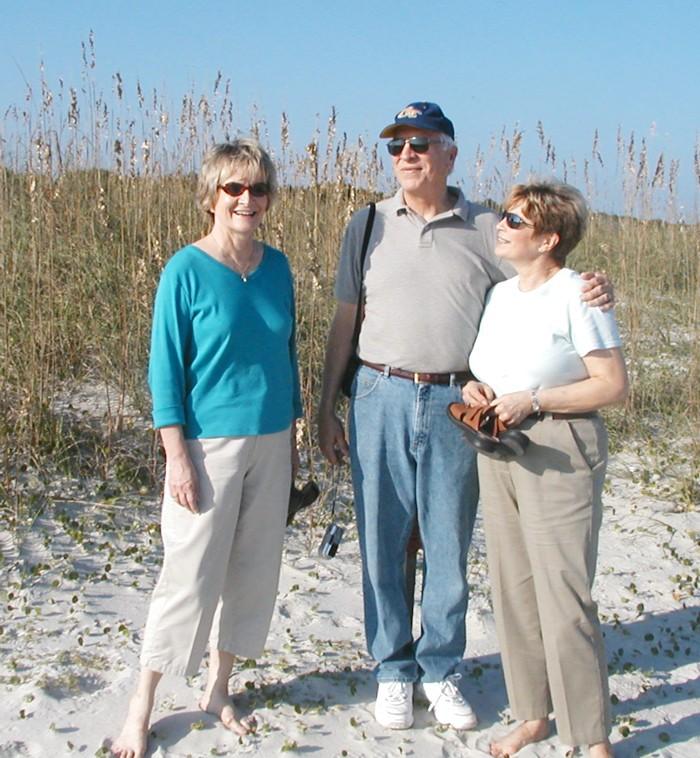
For the last few days we have enjoyed the company of long time friends, Bob and Patsy. We have supported one another through the joys and frustrations that are part of daily living for twenty years. So this time to share news, memories, and thoughts about the future is important to maintaining this special relationship. Each couple takes the term “friend” seriously and knows that we have to periodically renew the bonds that hold us together. We talk of our children, grandchildren and elderly parents. We compare books read and activities enjoyed. Both couples have relocated to new communities, established new relationships and are part of new churches. We have so many things to discuss. The men watch football and the women shop. We walk the beach and eat seafood. With the goodbye hugs, we know that our lives are richer because of this friendship. We have been blessed.
Wednesday, October 12, 2005
Tweens
Understanding and nurturing our preteens 9-13 years of age has become an important focus of our ministry at First Church. The current term for this age group is tweens. To help us in this effort, we have been most fortunate to engage Jim Williams to speak with us in March, 2006. Through his book, Parenting on Point and his DVD series, ProActive Parenting, Jim Williams helps parents and those who work with parents examine values and set priorities. Jim is a national parenting advocate and speaker and the director of Parent Education and Asset Development for STARS, a school-based program helping students make healthy lifestyle choices.
I am so excited that through a generous gift we will be able to offer this program about tweens to both parents and teachers March 3-4. We are striving to make this an offering to the community and to our conference, also. We have been blessed and are called to share that which will make a difference in our children's lives.
Parenting on Point is available in our church library.
I am so excited that through a generous gift we will be able to offer this program about tweens to both parents and teachers March 3-4. We are striving to make this an offering to the community and to our conference, also. We have been blessed and are called to share that which will make a difference in our children's lives.
Parenting on Point is available in our church library.
Sunday, October 09, 2005
Learning Partners

How wonderful to see our 5th graders and the Faith Connections class bridge the gap!(see previous post-Bridging the Gap) Together they visited the Mouse Pad and learned about Jacob and Esau through a variety of computer experiences. May these new friendships be important to all.
Friday, October 07, 2005
Children's Sabbath
This week we are joining many congregations, synagogues and mosques in remembering our call to meet the needs of children by being a part of the fourteenth annual National Observance of Children’s Sabbaths. The focus of this ecumenical and interfaith effort is “putting our faith into action to seek justice for children.” As I prepare the sermon for this Sunday, I am overwhelmed by the statistics of child poverty and neglect and am reminded of the following:
The Child’s Name is “Today”
We are guilty of many errors and faults
but our worst crime is abandoning the children,
neglecting the fountain of life.
many of the things we need can wait.
The child cannot.
Right now is the time bones are being formed.
blood is being made, senses are being developed.
To the child we cannot answer “Tomorrow.”
The child’s name is “Today.”
-Gabriela Mistral
The Child’s Name is “Today”
We are guilty of many errors and faults
but our worst crime is abandoning the children,
neglecting the fountain of life.
many of the things we need can wait.
The child cannot.
Right now is the time bones are being formed.
blood is being made, senses are being developed.
To the child we cannot answer “Tomorrow.”
The child’s name is “Today.”
-Gabriela Mistral
Thursday, October 06, 2005
Golden Calves
Recently, I have heard several sermons that referenced idols. Usually this word only reminds me of an image of a golden calf in the Old Testament. However, the repeated hearing of this word in a short period of time seemed like a sign for me to give idols more serious thought. Looking again at the scriptures, one finds that the people just don’t get it about idols. They keep making and worshiping idols again and again. This is a hot topic in the Bible.
Idols are still a hot topic. Our culture is as full of idols as Athens was in Paul’s day. We still have the idols of wealth, power, and success. Others may be objects of worship that are unique to our culture. In fact, this is probably not a good topic to explore during the collegiate football season. We can also acknowledge the idols of addictive substances, images of youth and beauty, status and material possessions. We believe somehow that what we can accumulate makes us who we are.
Moses discovered the uniqueness of God at the burning bush. God cannot be depicted or represented in any manner. Therefore, we constantly need to identify those things that have become idols in our lives and recommit ourselves to returning to the worship of God who said to Moses, "I am who I am." (Exodus 3:14). What is almost as amazing as our repeated idolatry is the fact that God always makes a way for us to return to God and accepts us when we come back.
Idols are still a hot topic. Our culture is as full of idols as Athens was in Paul’s day. We still have the idols of wealth, power, and success. Others may be objects of worship that are unique to our culture. In fact, this is probably not a good topic to explore during the collegiate football season. We can also acknowledge the idols of addictive substances, images of youth and beauty, status and material possessions. We believe somehow that what we can accumulate makes us who we are.
Moses discovered the uniqueness of God at the burning bush. God cannot be depicted or represented in any manner. Therefore, we constantly need to identify those things that have become idols in our lives and recommit ourselves to returning to the worship of God who said to Moses, "I am who I am." (Exodus 3:14). What is almost as amazing as our repeated idolatry is the fact that God always makes a way for us to return to God and accepts us when we come back.
Tuesday, October 04, 2005
Frederick Buechner
I am more familiar with Frederick Buechner's writings through their use within other person's works than his books. They always seem to be thought provoking. Today I saw the following quote:
"What is both Good and New about the Good News is that mad insistence that Jesus lives on among us not just as another haunting memory but as the outlandish, holy, and invisible power of God working, not just through the sacraments, but in countless hidden ways to make even slobs like us loving and whole beyond anything we could conceivably pull off by ourselves."
One of these days I am going to read more of Buechner's works in their entirety.
Sunday, October 02, 2005
The Christian Century
For over one hundred years, The Christian Century has examined a variety of subjects not only theologically, but also politically and culturally. The by-lines of this non-denominational periodical have been ones of the some of the outstanding Christian writers of each generation. Now The Christian Century articles may be read on-line.
This week I discovered "The Burden of the Gospels" by one of my favorite authors, Wendall Berry, on The Chrisitan Century website. This was very timely as I am currently facilitating our Jesus in the Gospels study and am trying to read them with new eyes. I appreciate the challenge that Wendall Berry finds in the Gospels and agree that there is a mystery of life that the Gospels can only partially reveal, but that we "are highly priveleged to live our way into." When we take them seriously we try to answer the question that Berry asks: "How must we live and work so as not to be estranged from God's presence in his work and in all his creatures?" He writes of the complexity of this question and one that calls for many answers. I concur with his final statement - "May heaven guard us from those who think they already have the answers."
This week I discovered "The Burden of the Gospels" by one of my favorite authors, Wendall Berry, on The Chrisitan Century website. This was very timely as I am currently facilitating our Jesus in the Gospels study and am trying to read them with new eyes. I appreciate the challenge that Wendall Berry finds in the Gospels and agree that there is a mystery of life that the Gospels can only partially reveal, but that we "are highly priveleged to live our way into." When we take them seriously we try to answer the question that Berry asks: "How must we live and work so as not to be estranged from God's presence in his work and in all his creatures?" He writes of the complexity of this question and one that calls for many answers. I concur with his final statement - "May heaven guard us from those who think they already have the answers."
Saturday, October 01, 2005
Comfort Food
I love the term “comfort food” and enjoy identifying certain foods as such. Some of those heading my list would include meatloaf and mashed potatoes and hearty vegetable soup and cornbread. Of course, homemade bread, ice cream and anything chocolate would also be included. I am not sure why I find so much comfort in such food, but I am sure it relates more to the power of memory than my taste buds.
The mention of these comfort foods evokes wonderful mental pictures. One is of my mother cooking and our family around the table in lively conversation. Another picture would be of me preparing these foods for Ron and two little boys in days past. Both pictures give me a sense of peace and security in a time when our world seems out of kilter. The resulting contentment inspires me not only to return to the kitchen, but also to be in relationship with others so that their memory of well-being will be fed.
The mention of these comfort foods evokes wonderful mental pictures. One is of my mother cooking and our family around the table in lively conversation. Another picture would be of me preparing these foods for Ron and two little boys in days past. Both pictures give me a sense of peace and security in a time when our world seems out of kilter. The resulting contentment inspires me not only to return to the kitchen, but also to be in relationship with others so that their memory of well-being will be fed.
Subscribe to:
Posts (Atom)

